The Contract Management Problem Nobody Has Fully Solved – Until Now
Every business runs on contracts. Sales agreements, vendor contracts, employment offers, partnership deals, NDAs, service agreements, licensing arrangements – they govern nearly every significant business relationship an organization has. The solution isn’t just better software or more organized filing systems. The solution is intelligence – and that’s exactly what Agentic AI workflows bring to contract lifecycle management.
And yet, for most companies, managing those contracts is still a largely manual, painfully slow, and surprisingly risky process.
Consider what a typical contract lifecycle looks like in a mid-sized organization. Legal drafts an agreement using a prior version as a template, manually updating clauses and terms. It gets emailed to a stakeholder for review. That stakeholder passes it to another. Someone redlines a section. A new version is created. The approval chain involves three departments, each with their own priorities and timelines. Weeks pass. By the time the contract is finally signed, the business opportunity it was meant to support has either cooled or been delayed.
And that’s when things go well.
When they don’t, contracts get signed with unfavorable terms that nobody caught. Renewal deadlines are missed. Obligations go untracked. Compliance requirements slip through the cracks. A single missed clause in a vendor agreement can expose a company to significant financial or legal risk.
The stakes are real: research consistently shows that companies lose between 5% and 40% of value on contracts due to poor management practices. Legal departments report spending the majority of their time on routine, repetitive contract tasks rather than strategic work. And in an era of increasing regulatory complexity, the compliance risks of manual contract management have never been greater.
What are Agentic AI Workflows?
Before getting into contract management specifically, it’s worth clarifying what sets Agentic AI workflows apart from traditional automation.
Traditional contract automation tools operate on predefined rules. If a contract value exceeds $50,000, route it to the CFO. If a clause contains the word “indemnification,” flag it for legal review. These are useful, but they are fundamentally reactive and rigid and they do exactly what they’re programmed to do, nothing more.
Agentic AI workflows are fundamentally different. AI agents don’t just follow rules – they reason, analyze, adapt, and act.
- They can read and understand the substance of a contract, not just its structure.
- They can identify a problematic clause even if it’s phrased in a way no previous rule anticipated.
- They can coordinate actions across multiple systems and stakeholders without waiting for human instruction at every step
- They can learn from outcomes and improve over time
In the context of contract management, this means moving from a world where software helps humans manage contracts – to a world where AI agents actively manage contracts, with humans providing oversight and handling the decisions that genuinely require human judgment.
The implications for legal operations, procurement, sales, and enterprise administration are profound.
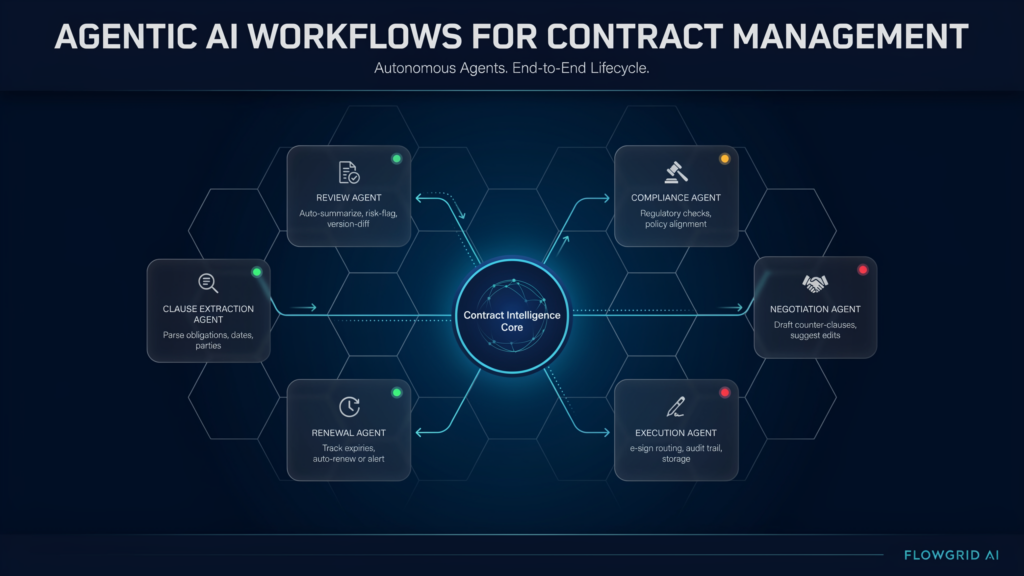
Agentic AI Workflows across the Contract Lifecycle
1. Contract Creation and Drafting
The drafting phase has traditionally been one of the most time-intensive parts of the contract process. Legal teams spend hours constructing agreements from scratch or adapting prior versions – a process that is both slow and error-prone.
AI agents transform this stage by generating contract drafts based on structured inputs. A sales representative entering deal parameters into a CRM – client name, contract value, service type, jurisdiction – can trigger an AI agent to produce a complete, customized first draft in seconds, pulling from approved clause libraries and applying the appropriate templates for the contract type.
The result isn’t a generic form. It’s a contextually appropriate draft that reflects the specific deal, the relevant legal standards, and the organization’s negotiating preferences – ready for human review rather than human construction.
Business use case: A technology company with a high-volume sales team uses AI drafting to reduce contract generation time from 3 days to under 30 minutes, freeing legal to focus on complex deals rather than routine agreements.
2. Clause Recommendations and Optimization
Even experienced legal professionals can miss opportunities to strengthen contract terms or inadvertently include language that creates downstream risk. AI agents trained on large volumes of contract data can analyze draft agreements and surface recommendations that improve clarity, strengthen protections, and align with organizational standards.
This goes beyond simple clause substitution. Sophisticated AI systems can evaluate the interplay between clauses – identifying, for example, that a liability cap in one section is undermined by an indemnification provision in another, or that a payment term conflicts with a termination clause.
AI agents can also benchmark contract language against market standards, flagging when terms are unusually favorable or unfavorable relative to comparable agreements.
Business use case: A procurement team uses AI clause analysis to identify that a standard vendor agreement contains an auto-renewal provision with insufficient notice requirements – a clause that had previously gone unnoticed and resulted in several unwanted contract extensions.
3. Risk Detection and Compliance Monitoring
Risk management is one of the highest-value applications of AI in contract lifecycle management. AI agents can analyze contract language against a comprehensive risk framework — flagging missing clauses, identifying unfavorable terms, detecting regulatory compliance gaps, and scoring overall contract risk.
For organizations operating across multiple jurisdictions, this capability is particularly valuable. An AI agent can evaluate whether a contract complies with GDPR data handling requirements, local employment law, industry-specific regulations, or the organization’s own internal policy standards – simultaneously and in seconds.
Beyond initial review, AI agents can monitor contracts throughout their lifecycle, alerting stakeholders when circumstances change in ways that affect compliance – such as when a regulatory update makes a previously compliant clause insufficient.
Business use case: A healthcare organization uses AI compliance monitoring to ensure that every vendor agreement involving patient data includes the required HIPAA provisions – automatically flagging any contract that falls short before it reaches the signature stage.
4. Automated Approval Routing
Approval bottlenecks are one of the most persistent sources of contract delay. Complex approval hierarchies, unclear routing rules, stakeholders who are unavailable or unresponsive, and poorly organized review processes all contribute to timelines that stretch far beyond what the business requires.
AI agents can manage the entire approval routing process dynamically. Rather than following a fixed sequence, an intelligent routing system can assess each contract’s characteristics – value, type, risk level, counterparty, jurisdiction – and determine the optimal approval path. It can assign reviewers, set deadlines, send reminders, escalate when thresholds are missed, and track approval status across all active contracts in real time.
Crucially, AI agents can distinguish between contracts that require deep legal review and those that are routine and low-risk — routing them accordingly and preventing high-volume, straightforward agreements from consuming disproportionate legal resources.
Business use case: A financial services firm reduces average contract approval time from 18 days to 4 days by implementing AI-driven routing that automatically distinguishes between standard, expedited, and complex review tracks.
5. Contract Negotiation Support
Negotiation is an area where AI supports rather than replaces human judgment – but the support it provides can be transformative.
AI agents can analyze counterparty redlines in real time, identifying which proposed changes represent standard market practice. They can surface historical data on how similar terms were negotiated in previous agreements — and what outcomes resulted. They can suggest alternative language that addresses a counterparty’s concern while preserving the organization’s key protections.
For legal teams managing dozens of simultaneous negotiations, AI negotiation support dramatically increases throughput without sacrificing quality. For business teams without dedicated legal support, it provides a level of guidance that would otherwise be unavailable.
Business use case: A professional services firm uses AI negotiation tools to reduce the average number of negotiation rounds per contract from 4.2 to 1.8 – accelerating deal close times and reducing legal costs per engagement.
6. Obligation Tracking and Deadline Management
Signing a contract is not the end of the process — it’s the beginning of a series of obligations, milestones, and deadlines that must be tracked and fulfilled. For organizations managing hundreds or thousands of active contracts, this is a significant operational challenge.
AI agents excel at obligation extraction and tracking. After a contract is executed, an AI system can read the agreement, identify every time-bound obligation and milestone, and populate a centralized tracking system with deadlines and responsible parties. It can send proactive alerts as deadlines approach, escalate when obligations are at risk of being missed, and maintain a complete audit trail of compliance activity.
Business use case: A real estate company manages over 600 active lease agreements. AI obligation tracking automatically monitors rent escalation dates, renewal options, maintenance obligations, and notice requirements — eliminating the missed deadlines that had previously cost the company in penalties and lost negotiating leverage.

7. Intelligent Document Analysis
Not all contracts arrive in tidy, structured formats. Organizations routinely inherit legacy agreements, receive third-party paper, and deal with documents in a variety of formats and styles. Extracting consistent, actionable data from these documents has historically required significant manual effort.
AI agents capable of intelligent document analysis can read contracts of any structure or format and extract key data points — parties, dates, values, terms, obligations, governing law, renewal provisions — and populate contract management systems automatically.
Beyond data extraction, intelligent analysis can surface insights across a portfolio of contracts: identifying clusters of risk and benchmarking terms across vendor relationships.
Business use case: A multinational corporation acquires a smaller company and inherits 1,400 contracts in various formats. AI document analysis processes the entire portfolio in 48 hours, extracting key terms and flagging 23% of agreements as requiring priority legal review — work that would have taken a team of lawyers several months to complete manually.
8. eSignature Coordination
eSignature workflows are a natural integration point for Agentic AI systems. Once a contract has been drafted, reviewed, negotiated, and approved, an AI agent can automatically coordinate the execution process. Sending the document to the correct signatories in the correct order, managing authentication requirements, sending reminders, and confirming execution.
Beyond simple routing, AI agents can manage complex multi-party signing workflows — coordinating sequential signatures across internal and external parties, handling conditional signing requirements (e.g., Party B’s signature is required before Party C’s), and flagging incomplete execution before documents are filed.
The combination of AI workflow management and eSignature technology compresses what was once a multi-day process into a matter of hours — or, for routine agreements, minutes.
Business use case: A staffing agency processing 200+ employment agreements per month uses AI-coordinated eSignature workflows to reduce average execution time from 3 days to under 4 hours, eliminating manual follow-up and improving new hire experience.
Recommended Read: Sign, Send, Succeed: How eSignatures are Accelerating Business Growth
9. Contract Renewal and Expiration Management
Missed renewals are one of the most avoidable and costly contract management failures. An auto-renewing agreement that no longer serves the business, or a critical vendor relationship that lapses due to an unnoticed expiration, can create significant financial and operational problems.
AI agents monitor every contract in a portfolio for approaching renewal and expiration dates – and do more than just send alerts. They can analyze the performance of an existing agreement, surface relevant market data, and generate a preliminary renewal recommendation based on the contract’s history and current business context. This gives stakeholders the information they need to make informed renewal decisions well in advance of the deadline.
For contracts where renewal is routine and terms are unchanged, AI agents can initiate the renewal process autonomously — generating updated documents and routing them for approval without requiring manual intervention to begin the process.
Business use case: An enterprise SaaS company uses AI renewal management to eliminate all missed renewal deadlines across its 340-vendor contract portfolio, while also generating data-driven renewal recommendations that improved renegotiated terms in 31% of cases.
The Business Case: Why AI Contract Management Delivers Measurable Results
The benefits of Agentic AI workflows in contract management are not theoretical — they translate directly into outcomes that matter to the business:
Faster turnaround times. Organizations implementing AI contract workflows typically reduce contract cycle times by 50–80%. Deals close faster, vendors are onboarded sooner, and revenue is recognized earlier.
Reduced operational costs. By automating routine drafting, review, routing, and tracking tasks, AI significantly reduces the time legal and operations teams spend on administrative contract work – freeing them for higher-value activities.
Improved compliance and governance. AI monitoring ensures that compliance standards are applied consistently across every contract, not just the ones that happen to receive close attention. This is particularly valuable in regulated industries and cross-border operations.
Increased accuracy. Human reviewers miss things. AI agents, applied consistently and trained on comprehensive risk frameworks, catch a higher percentage of problematic terms and missing provisions.
Enhanced visibility and reporting. AI-powered contract management systems provide real-time dashboards across an organization’s entire contract portfolio. This visibility enables better business decisions.
Better stakeholder collaboration. By automating coordination tasks and providing all parties with real-time access to contract status, AI reduces the friction and miscommunication that characterize manual contract processes.
Scalability. As organizations grow, contract volume grows with them. AI-powered systems scale without requiring proportional increases in headcount.
The Future of AI in Contract Lifecycle Management
We are still in the early stages of what AI will ultimately make possible in contract management. The capabilities available today – impressive as they are – represent a foundation, not a ceiling.
In the near term, expect AI agents to become increasingly autonomous in handling routine contract matters end-to-end: drafting, routing, negotiating standard terms, executing, and filing. Human oversight will shift from process management to strategic review.
As large language models continue to improve, AI agents will develop deeper legal reasoning capabilities – moving from pattern recognition to genuine contractual analysis that can interpret ambiguous language, assess implications across interconnected agreements, and provide counsel-quality insights at scale.
AI will also increasingly operate across organizational boundaries. Rather than a single company’s AI managing its contracts, future systems may facilitate AI-to-AI negotiation between counterparties – accelerating routine commercial transactions while preserving human oversight for genuinely complex or high-stakes decisions.
For procurement, the implications are significant: AI agents that understand spend categories, supplier performance, and market conditions could negotiate vendor agreements at a level of sophistication and consistency that no human team could achieve across a large supplier base.
For legal operations, the shift is already underway. The legal department of the future is not smaller – but it is fundamentally differently composed. Routine contract work is handled by AI. Legal professionals focus on judgment, strategy, and the complex human elements that no algorithm can replace.
Where to Start: Evaluating AI Contract Management for Your Organization
AI-powered contract management is no longer a future possibility reserved for large enterprises with significant technology budgets. A growing ecosystem of solutions makes these capabilities accessible to organizations of all sizes.
As you evaluate options, consider these priorities:
Start with your pain points. Where does your contract process break down most consistently? Long approval cycles? Missed renewals? Compliance gaps? High-volume drafting? Identify your highest-impact opportunity and look for solutions that address it directly.
Prioritize integration. AI contract management delivers maximum value when it connects with your existing systems. Evaluate how well candidate solutions integrate with your current technology stack.
Assess the AI’s depth. There is a significant difference between a contract tool that uses AI for search and a system where AI agents actively analyze, recommend, and act. Understand what the AI actually does — and what it doesn’t.
Consider change management. Technology adoption is a people challenge as much as a technology challenge. Solutions that fit naturally into existing workflows and provide clear value to end users achieve higher adoption rates than those that require significant behavioral change.
Plan for governance. AI agents making decisions about contracts require appropriate oversight structures. Establish clear policies about which decisions require human approval, how AI recommendations are reviewed, and how system performance is monitored.
The Competitive Advantage is Available Now
The organizations that will define the next era of commercial operations are not waiting for AI contract management to mature. They are building the capability now — establishing the data foundations, implementing the workflows, and developing the organizational competencies that will compound in value over time.
Contracts are the operating system of business relationships. Making that operating system smarter, faster, and more reliable isn’t just an efficiency gain – it’s a strategic advantage that shows up in deal velocity, risk exposure, vendor relationships, and legal costs.
Agentic AI workflows are not coming to contract management. They are here. The question is not whether to adopt them — it’s how quickly your organization can capture the advantage.
Start by auditing your current contract lifecycle. Map where delays, errors, and risks concentrate. Identify the workflows most amenable to intelligent automation. Engage vendors who can demonstrate real outcomes – not just features. And build toward a contract operation that is faster, smarter, and more resilient than anything a purely manual process could produce.
The contracts that govern your business deserve the most capable management you can give them. Agentic AI workflows make that possible — today.
This blog article was brought to you by Signly. Create beautiful contracts, proposals, signatures, and take payments in a single link with AI-powered automation. Sign up today