
Imagine closing a deal after weeks of careful relationship-building – only to watch momentum stall because the contract is stuck in a separate system, waiting on approvals that nobody can track. This scenario plays out daily in businesses across every industry.
Sales teams nurture leads in their CRM. Legal drafts contracts in a document folder. Operations manages renewals in a spreadsheet. Each group works diligently, yet the gaps between these systems cost real money: delayed deals, duplicated data entry, missed renewals, and customers who experience friction at exactly the moment they should feel most confident in your organization.
The solution isn’t simply better software, it’s a strategic alignment between Customer Relationship Management (CRM) and Contract Lifecycle Management (CLM). When these two systems work together, businesses gain a unified view of the entire customer journey, from first contact to long-term renewal. The result is faster sales cycles, stronger customer experiences, and measurable revenue growth.
The Cost of Disconnection
Most organizations don’t set out to create data silos. They adopt a CRM to manage leads and pipeline, then later add a contract management tool to handle agreements. Without a deliberate integration strategy, these systems become islands — each valuable on its own, but unable to communicate.
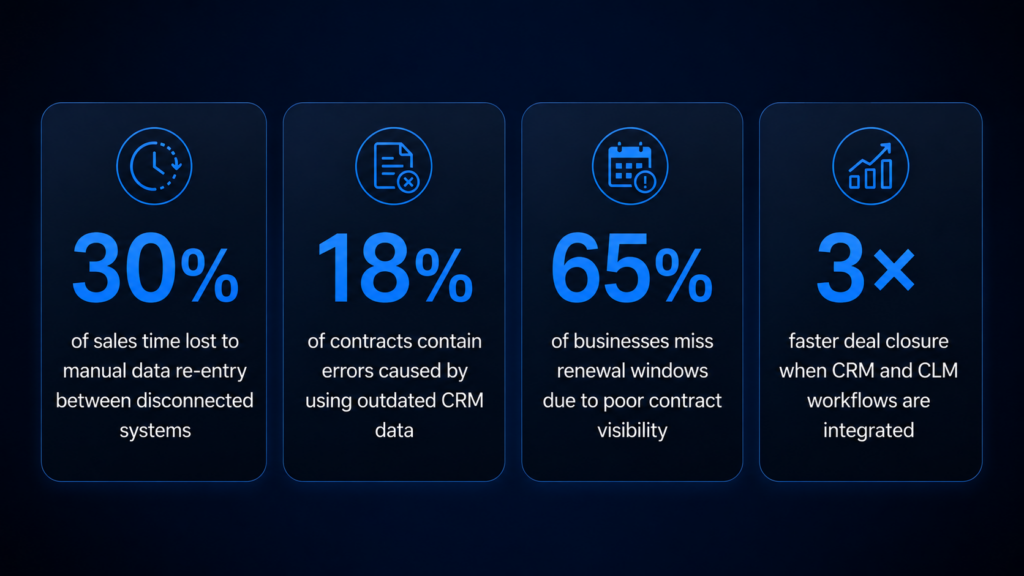
The consequences are tangible. Sales reps spend hours copying deal terms from CRM records into contract templates. Legal teams request customer data they can’t access from contract systems. Account managers miss renewal dates because nobody set up an alert in either system. And customers – who have no visibility into any of this – simply experience slow, frustrating processes.
How CRM and Contract Management Complement Each Other
The customer lifecycle is not a series of isolated events — it is a continuous journey. CRM and contract management are not separate business functions; they are two sides of the same relationship. Understanding where they intersect is the foundation of any growth strategy.
“When customer data and contract workflows live in separate systems, revenue leaks through the cracks. Unifying these two functions drives faster deals, stronger relationships, and sustainable growth.“

Uyi Abraham
/
CEO, Vonza
The Customer Life Cycle
Lead generation & qualification: CRM captures prospect data and qualification signals. Ultimately, Integrated CLM surfaces past contract history with similar accounts, informing negotiation strategy before the first conversation.
Sales pipeline management: Deal stages in CRM trigger contract preparation workflows automatically. No deal moves to “negotiation” without a corresponding contract draft already in motion.
Proposal & quote creation: Pricing, product terms, and customer-specific conditions flow directly from CRM data into contract templates.
Contract drafting & approvals: Automated workflows route contracts to the right approvers based on deal value, customer tier, or risk level.
eSignature collection: Digital signature integrations linked to CRM deal records let both parties sign in minutes. Executed agreements are automatically attached to the customer record.
Customer onboarding: Contract execution triggers onboarding workflows inside CRM: task creation, welcome sequences, and handoff to customer success.
Renewals & amendments: Renewal dates and contract terms visible inside CRM give account managers 60–90 day advance notice, turning reactive renewals into proactive relationship conversations.
Upselling & cross-selling: Contracted usage limits, product entitlements, and service scope — surfaced in CRM — reveal natural upsell triggers at exactly the right moment in the customer relationship.
Customer retention: A unified view of contract health, usage patterns, and relationship history enables customer success teams to identify at-risk accounts and intervene before churn occurs.
Common Business Scenario
A mid-size software company closes a deal in Salesforce on a Friday afternoon. By Monday, the deal details must be manually re-entered into the contract platform, reviewed, sent for internal approval, and only then forwarded to the customer. What should take hours takes five business days and sometimes the customer has already started evaluating alternatives.


The Business Benefits of Integration
When CRM and contract management systems are aligned through thoughtful integration, the benefits compound across every team that touches the customer lifecycle.
01
Faster Deal Closure
Automated contract generation from CRM data eliminates manual handoffs, reducing contract cycle times by days or weeks.
02
Better Customer Experience
Customers receive accurate, personalized contracts quickly — reinforcing confidence in your organization at the most critical moment.
03
Cross-Team Visibility
Sales, legal, operations, and customer success share a single source of truth — reducing miscommunication and status meetings.
Building the Business Case for Integration
For operations leaders and business owners making investment decisions, the case for CRM and contract management alignment rests on three pillars: efficiency, visibility, and revenue protection.
Efficiency means fewer handoffs, less rework, and faster processes. Every hour a sales rep spends re-entering data into a contract system is an hour not spent building customer relationships. Integration reclaims that time and redirects it toward revenue-generating activity.
Visibility means every stakeholder — from the CEO to the account manager — can see where a deal stands, what’s been agreed, and what’s coming up for renewal. Decisions get made faster when information doesn’t require hunting across three different systems.
Revenue protection means no missed renewals, no unanticipated contract expirations, and no customers who slip away because nobody noticed their contract was up. Integrated systems create automatic early-warning systems for the revenue you’ve already earned.
The Future: AI, Automation, and Intelligent Contract Management
The alignment of CRM and contract management is not a static achievement — it is the foundation for a more ambitious digital transformation. Emerging technologies are deepening this integration in ways that were impractical just a few years ago.
AI-Powered Contract Intelligence
Artificial intelligence is transforming contract management from a document-storage function into a strategic intelligence layer. AI-powered contract review tools can – agreement terms, flag non-standard clauses, compare language against approved templates, and surface risk factors — automatically, at scale. When these insights feed into CRM, sales and customer success teams gain contract intelligence they can act on in real time.
Predictive Renewal and Churn Management
By combining CRM engagement data — login frequency, support tickets, feature usage — with contract data — contract value, renewal dates, amendment history — predictive models can identify accounts at risk of churn months before a renewal conversation would traditionally begin. This gives customer success teams a decisive advantage: time to intervene, add value, and secure renewals proactively rather than reactively.
Automated Revenue Operations
The convergence of CRM, contract management, billing, and revenue recognition into unified Revenue Operations (RevOps) platforms is accelerating. Businesses that have already aligned their CRM and CLM workflows are best positioned to extend that integration into automated billing triggers, usage-based pricing adjustments, and real-time revenue recognition — creating a fully automated revenue engine that scales without proportional headcount increases.
Intelligent Document Generation
Large language models and intelligent document automation are making it possible to generate first-draft contracts tailored to specific customer profiles, deal terms, and risk parameters in seconds. Integrated with CRM data, these tools eliminate the template-selection and data-mapping steps that currently slow contract generation — compressing the path from verbal agreement to executed contract to a matter of minutes.
Where to Start: A Practical Roadmap
For organizations ready to align their CRM and contract management functions, the path forward doesn’t require a complete systems overhaul. Most integrations can be built incrementally, delivering value at each stage.
Audit your current state. Map every point in your customer lifecycle where data moves between CRM and contract systems. Identify where manual handoffs, re-entry, and visibility gaps create friction.
Prioritize high-impact integration points. For most organizations, the highest-value integrations are deal-triggered contract generation, eSignature status syncing back to CRM, and renewal date alerts surfaced in CRM dashboards.
Evaluate native integrations. Many leading CRM and CLM platforms offer pre-built integrations that can be configured without custom development. Start there before investing in custom API work.
Align your teams. Technology integration is only half the equation. Sales, legal, operations, and customer success teams need shared workflows, agreed naming conventions, and a common understanding of who owns what in the integrated system.
Measure and iterate. Define success metrics before you launch — contract cycle time, renewal rate, data entry hours saved — and use them to guide continuous improvement.
This blog article was brought to you by Signly. Create beautiful contracts, proposals, signatures, and take payments in a single link with AI-powered automation. Sign up today